Showing posts with label movies. Show all posts

Wednesday, January 25, 2012

Academy Awards 2012 Nom-Noms, Movies about Movies about Acting in Movies


You might have noticed I haven't been posting much here, mostly because my reviews of terrible movies have been picked up by JustPressPlay. But it's that time of year again to talk about the movies that are supposed to be not-terrible, but usually are. That's right, it's The Oscars: Not Accounting for Taste since 1929.


Last year's awards were a potpourri with the gentle scent of Mediocre Medley. This year seems to be no different.

Best Picture
The Descendants might be the only movie for adults on this list, in that it's concerned with taking apart illusions rather than building them up. Midnight in Paris was a cute ball of childish fluff, and I'm just not sure how it's any different from the last ten years of (roughly equivalent) Woody Allen films that it suddenly deserves an Oscar nod. (Match Point was the best thing he's done since the 90s, and that only got a writing nod.)

Speaking of pervy old men, look at Speilberg with War Horse and Scorsese with Hugo. Neither of them have made a truly great movie in forever. Is the Academy so desperate for role models that it needs to trot out a gray-haired American auteur or two for every ceremony? True, the red carpet wouldn't quite be the same without Scorsese's eyebrows bobbing somewhere along it, wafting up and down lazily and independently, like drinky birds.

Also note the absence of an Eastwood this year, both he and DiCaprio have been snubbed for J. Edgar. This might be the first awards in a while where we're spared having to watch Leo fail to win anything.


Best Actor
Gary Oldman is a bit of a surprise here, since Tinker, Tailor skated by theaters without too much notice like a cold war spy. On skates. But Oldman's nomination is curious since in Tinker, Tailor he basically plays Alec Guinness. Now look at Brad Pit playing Robert Redford in Moneyball, Dujardin playing any number of silent actors in The Artist, and George Clooney playing, well, George Clooney. All of these characters are throwbacks. Are movies becoming increasingly about movies? I predict that in a decade the only award-winning acting will be Marlon Brando impersonations.

A notable snub this year is Michael Fassbender, for his poignant and full-frontal portrayal of guilt and sex addiction in X-Men: First Class.

Of course, Pitt deserves an Oscar nod for trying his hardest not to be sexy (a great, ultimately futile effort). And Clooney deserves an Oscar nod for his salt-and-pepper hair. Or, rather, his hair deserves its own category. Best George Clooney hair in a George Clooney movie (Comedy or Musical).


Best Actress
Most of the buzz here is going to Michelle Williams in My Week with Marilyn for the much-covetted "Playing Someone Who Couldn't Act" award. Viola Davis needs a separate "Putting Up with White Folk" award. The statuette will be of Nichelle Nichols.


Supporting Actor/Actress
And the Oscar goes to: Jonah Hill! Did you just die a little inside right there?

Writing
Usually my favorite category, this year is basically a mess. "Original Screenplay" has two foreign films, two comedies, and one Sorkin-esque docudramady ("Best Fast Talking about Important Matters in a Non-Sorkin Film, Or, the In The Loop Award"). Adapted writing has one novel (The Descendants, one sort-of-novel (The Invention of Hugo Cabret), one play (The Ides of March), one non-fiction (Moneyball), and one movie/novel (Tinker, Tailor).

My Predictions:
are that it will be a five-hour waste of time but I'm going to watch it anyway. Also Billy Crystal will make one dirty joke too many and end up with more than he bargained for when Viola Davis takes him home.

As usual I'll be watching as many of these films again or for the first time over the next month. I'll be writing quick reviews here on the fly about how terrible they all are and how the apocalypse must surely be coming. Can't tell you how much I'm looking forward to it.


Monday, March 08, 2010

82nd Annual Academy Awards, Oh My God What Have I Been Doing for Three and a Half Hours


Well, the only thing surprising about this year's Oscars was how unfunny the hosts were. Hollywood pays enough money for this fiasco, you'd think they could afford some not-awkward.

Also it contained the most inappropriate interpretive dance number in the history of inappropriate dance numbers.

Also wtf sandra bullock.

Thursday, March 04, 2010

Award Season Ramp-up Round-up: Down to the Wire!


There is a particular joy in the art direction of Fantastic Mr. Fox, where the scenery and all the action is flattened into two dimensional planes, the background sttretched up and out like a renaissance landscape. Unlike in a traditional animation (or god forbid cgi) the subjects on screen are real, tangible, three-dimensional objects: puppets, lovingly matted and choppy, walking about in colorful, detailed sets so meticulous you can almost smell the rubber cement. Yet these detailed, 3d objects are smooshed into two-dimensional planes and the effect is like having your head stuck in a diorama, or a toybox, where everything's it's own little fascinating anthill. Like in some of the fantastic 2D platformer games that have come out in the last few years you get the sense that although this is a stylized reality nothing has been lost in the stylization. A reduction that enhances. At no point does it feel like a cartoon and at no point does it feel like a movie. It's its own world, which is what an animation should be.

Which isn't to say Mr. Fox is all that great. It's near-impossible to judge Wes Anderson movies as movies, mostly because they refuse to be taken as such. They're kind of like a disaffected Gen X'er on the other side of the room at a party. Interesting, talkative, defensive, flawed but he'd never call them flaws, petulant but (he says) always justifiably so. And above all he never approaches you — you're either interested or you aren't.

Sometimes it works. I was taken in by The Life Aquatic for its unabashed childishness, it was so loudly and uncompromisingly a labor of love, a big, expensive non-commercial romp in the toybox of aging adolescants. (The 2d-flattening effect was also used to great effect here — suddenly the submarine becomes a great big toy, of Bill Murray's yes but mostly Wes Anderson's, and we get to play around in it with him.) Other times he's less convincing. I thought The Darjeeling Limited, for example, failed to gel around anything other than its leading men's self-fascination.

So we know We Anderson movies have certain plot points and certain characters, and there's only one lesson anyone ever learns (the only lesson one really can learn by himself alone in a sandbox, "I'm a little crazy, yes, but I can't help it.") Mr. Fox hits these points no better than any other Anderson movie, so in terms of that it's pretty mediocre. But there's still some fun to be had watching a creator plays with his creations, especially when those creations get away from him as they often do, here probably more than in any other of his films.

The dialogue of course is sparkling and the cast a screenwriter's wet dream. But if you were expecting Anderson to grow up anytime soon, well, no cussing way.

Tuesday, January 19, 2010

Award Season Ramp-up '09 pt2

Wherein the author continues to watch as many award-season movies as possible, jotting thoughts down as soon after viewing as he can.


An Education is sweet and full of texture, it brought to life both the drab and the excitement of 60s Britain without really choosing sides: The drab is also comfortable and cozy. The exciting is also shady, strange. It's somehow wrong, wrong in ways you can't quite explain other than that it's not comfortable or cozy. That David is also somehow wrong we know right from the start, and as we and Jenny learn more about him the wrongness gets clearer and clearer until it's blatant, inarguable. But he was always wrong, and the movie handles this well, he never becomes any less or more than he is right there at the beginning. Only Jenny is changing.

The movie loses ground only when Jenny starts to become the voice of authorial arguments, delivering speeches to blank-faced adults who could very well offer a counter-argument but never do. Maybe that's the point though, she has to learn on her own, the adults in her life are of no help, not unless she wants their help. These other roles really make the movie though. Her father is played brilliantly by Alfred Molina, he exudes care and love and worry even while yelling, you just want to give him a hug every time he talks. Emma Thompson as the school headmistress is exactly the opposite, she never needs to show that she cares. She's only in a few short scenes and mostly on the quiet end of a Jenny-speech, but just in not arguing with Jenny she makes probably the strongest argument in the movie. These two performances balance the story, a cartoonish portrayal of either would have ruined it from the start.

Also excellent was Rosamund Pike as the trophy-girlfriend Helen, who manages to be dumb yet sweet without being too dumb or too sweet. Again, a cartoonish portrayal would have killed it.


Bad Lieutenant: Port of Call New Orleans. Herzog movies generally take place in a world somewhere between the realities and the delusions of his main characters, and in this movie even the obvious fantasies: iguanas, break-dancing souls, etc, don't mark a clear line between reality and unreality. They're real to Nicholas Cage, and that's all that really matters. As the plot gets increasingly convoluted and nonsensical you might start to wonder if we're all tipping into fantasy-land with him. But no, turns out it's no more or less real than it ever was.

And Cage's performance is so strange, mostly because he's clearly wrong for the part. He walks around hunched over in suits too big for him, moving like he's fifty pounds heavier than he is, yelling like he has a voice for yelling. (He doesn't have a voice for yelling. He sounds more like a frustrated English professor than a professional, no matter what movie he's in.)

But Cage is fabulous at being miscast, I can't think of any other actor who so deliberately seeks out roles he is completely wrong for. If this movie were another Harvey Keitel vehicle you could imagine the Lieutenant as being actually frightening, actually loathesome, actually at times courageous and at times charming. With Cage, we have a character who is none of those things. He's nothing at all really, just confused and in pain, and the movie is better off for it.

The point of the movie seems to be that there's things out there (reptiles, water) that disaster lets in and once they're in they take hold and get stronger and stronger until at the end you're drowning in them.

Cage's question at the end is "Do fish dream?" Herzog's answer seems to be "Yes, they dream this movie."


Bright Star is a well-needed reminder that poetry, as it is in the first line we hear of Keats, is a joy, cut of the same cloth as a walk in flowered fields or throwing pebbles in a lake or sitting in front of an open window on a windy day — though more than a hundred years have almost convinced us that these things aren't enough, as if there were something that was more of life than these simple, fleeting moments. In the movie, Mr. Brown is an annoying, heavy-handed reminder of what poetry shouldn't be: vain, self-serving, cynical, serious, witty in the service of pettiness, "modern" in the service of fear. Though he's a reminder of what a poet has to deal with you often he's far too despicable to have as much screen time as he does. Keats however is portrayed as playful first and melancholy second, a welcome departure from the brooding Byronic figure you come to expect from movies about poets. Movies in general aren't keen on geniuses, they'd much rather focus on common people in uncommon circumstances, public figures — genius is too private a thing to translate well to a medium that is public at every stage of production and consumption. Intimacy in a film is a difficult and necessary illusion, which is why the love story is practically the definition of film: A love between two people is both private, between each other, and public, seen by each other. It is the smallest unit of intimacy that can be put to film.

The production is very lush and surprisingly intimate, and manages the difficult task of making a period piece not look like a set piece. Some shots have the heaviness of a painting, and though this takes you out of the story a little it also reminds you of what you're in. The movie is brimming with poetry, in the dialogue as well as the visuals.

It all turns to misery of course, and Campion is a Romantic enough to embrace the misery as much as the joy. Everything may turn to misery in time, and everyone may die, but in those bright moments of not-misery there is a promise and a hope that misery might never return. The young sister Toots is a heartbreaking reminder of this as she banishes autumn from her garden. In some world, she succeeds.

As for the love story, it's strange. The courtship is short and full of jousts and lots of silences, and you get the sense that the most they know of each other are those silences, that they are filling those silences with dreams of each other. Like love was a dream they were wishing each other into, and in so faling in love themselves. You never once suspect in the end that they actually know each other, or even themselves (they're so young!). And in that sense it's a very honest love story, and a very true one. And very powerful.

Also, that cat should win best cat acting by a cat in a non-cat movie.
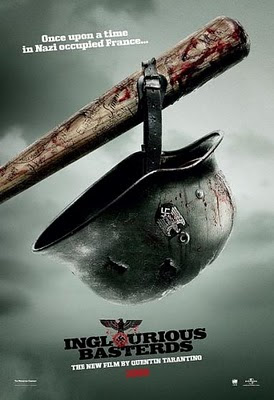


What was surprising about Inglourious Basterds is not that it's bad — and it is bad, very bad, "What were you thinking?" type bad &mdsash; but that it's poorly made. We don't expect a Tarantino movie to be drab, his characters lifeless and their motivations a mystery. We expect explosive wit and familiar throwbacks. We expect larger-than-life characters pitted against each other in a ridiculous and ultimately satisfying orgy of genre tropes. But the only larger-than-life characters in this unsatisfying movie are The Nazis and The Jews, the individuals are almost nondescript. His Nazis are luxuriously evil, slippery and smarmy and nasty, sometimes brave, sometimes cowardly. If only he cared nearly as much for his so-called-protagonists, but to call them cookie-cutter would be an insult to creative bakers. The only one of any interest is Brad Pitt's Aldo, who is clearly not Jewish. The rest are so well summed up by their nicknames ("The Bear Jew," etc) they don't even need to have lines (and many don't).

But the names Nazi and Jew are red herrings, this movie would more honestly (and far less offensively) be set on Mars, with some evil Martian Socialist Party hunting down ethnic barsoomians or something. But the fact that the movie makes no sense (and the movie makes absolutely no sense) is secondary, we could forgive even that if it were in the least bit interesting. The script is set up as a series of verbal confrontations, some of them twenty or thirty minutes long, and an ordinary director would play these heated conversations as a buildup of tension, putting off the release until the last possible moment until it explodes, generally in gunfire. Instead, Terantino has these scenes play out normally, as if nothing were happening at all. The audience knows something is at stake, the characters know something is at stake, yet no one acts as if something is at stake — giving an overall impression of watching boring people talk about boring things which something interesting just might be happening somewhere else. Like having to sit through a discussion of hog futures on the deck of the Titanic. And because there's no tension when the release comes it feels less like a climax and more like a "What just happened?"

The problem here is clearly that Tarantino has developed a sort of auteur's arrogance, he expects us to believe whatever he tells us. He says this crack commando team has killed so many Nazis behind enemy lines that even Hitler is afraid, we're supposed to believe him (even though all this Nazi-killing supposedly happens in the jump cut between the "Let's kill Nazis" scene and the "Hitler is afraid" scene). He says Eli Roth is somehow fearsome, we're supposed to believe him. He says that movies can end the war, we're supposed to believe them. Sure none of it makes any sense, but he doesn't seem to even lift a finger to try to convince us, which is both lazy and unforgivable.

The joy of Kill Bill or Pulp Fiction or Reservoir Dogs was in things we've seen already, familiar themes and tropes and body movements and dialogue, for what is "genre" but something the audience already believes without you having to tell them? Inglourious Basterds is a departure from that. Things are still familiar, god knows he doesn't have an original bone in his body. But they don't feel familiar. They feel rather shoddy.

Tuesday, January 12, 2010

Award Season Ramp-up Round-Up '09, part1

Every year around this time I try to see as many best-of-year films as possible, that way when Oscar night finally comes around I have that much more to be aggravated about. Generally I don't document it as best as I could, but this year I've decided to make the effort to get it all down, generally as soon after I see the movie as possible.

I've already seen Public Enemies and Avatar. So here we go!


THE HURT LOCKER
Fantastically realistic (or realistic-seeming, who knows if it's even remotely actually-realistic). So much so that little bits that didn't seem realistic stood out more, even a single canned sound effect was enough to jar me out of it for a second. Also unconvincing, that tendency for any squad in any action movie to be immediately qualified for any operation, no matter if more experienced troops are probably waiting by (Miami Vice-itis). The glimmerings of a plot thankfully they petered out, as if to say: here's the sort of movie you're expecting to see, but this isn't that movie.

There are no superior officers to be found, there are no consequences beyond the physical damage to the squad (almost entirely from themselves and each other), and there is no enemy -- everyone is treated equally as an enemy, allies, friendlies, squadmates. And it's an interesting consequence of a bomb squad that there really is no enemy: there's only it, and you, and what you do or do not do to it. It has no will or plan or purpose.

So war is a bomb, and the bomb is a drug, and the soldiers are addicts and they either see it and quit or they keep at it. The only way to view James is as an addict, and as an addict he serves a necessary purpose in the war, a purpse that the movie clearly admires. But this purpose is not a moral one, he doesn't save lives or make things safe for his countryment -- the more he cares the worse he is at his job. He can't actually make a difference. His purpose is as inexplicable as the bomb's.

Avatar is the triumph of a gamer, an ultimate gamer's fantasy where the gameworld becomes more important than real life. Hurt Locker is nearly identical in that regard, they're about addicts who give into their addiction. And for all its brutality, Hurt Locker still glorifies the addiction. But that's the question, isn't it? Is James really being "All he can be"? Or has war made him less than he could have been? All we really know is that when he's in the suit he's all that he is.

Interesting that we've been talking about how '00s movies are specifically amoral, their exemplary heroes aren't anti-heroes (who do wrong things for the right reasons), they're the opposite: they have the wrong reasons and whether their actions are good or not is entirely up to chance or circumstance.

We'll see if it continues with Bad Lieutenant.

Wednesday, December 30, 2009

Blue Men Group, Ripley-is-not-Amused, and The Subjugation of the Natives: The Game: The Movie


Ended up seeing Avatar (due to familial obligations, I swear!).

I can see why some people liked it, though I was far too annoyed by the middle to be able to stomach the guns-and-dragons-for-forty-five-minutes climax. This is what white people do, they eradicate populations then overidealize them afterwards in order to make themselves feel better. This movie, like some reviewer said, is entirely Ferngully meets Dances With Wolves — and Dances With Wolves is probably the most demeaning two-and-a-half hours ever set to cinema. District 9, though not a great movie (it couldn't decide where allegory ended and action movie began) at least treated culture clash more realistically than Avatar, which ends up being your basic white male fantasy.

In terms of biology the movie was fascinating and detailed, though they don't even make an effort to make Pandora seem like an actual alien world. The template is an oversized, primordial earth. Notice how the dragon-things all have four wings — just like the first flying lizards on earth.

Anthropologically it was less than interesting. The Na'vi both facially and phonetically resemble indigenous post-slave-trade Caribbean Indians, so Pandora is basically Hispanola with flying mountains. Like in all white-man-goes-native movies, the male tribesmen are stubborn, strong and ugly (though easily bested by the hero in combat) and the women are fierce, oversexualized and all for a little miscegenation.

Movies like this tend to forget that native americans didn't have horses until Europeans brought them over, and the supposed natural connection between man and beast that Native Americans exemplify depended entirely on beasts being previously domesticated. People forget that a successfully culture must reshape the landscape around it, must subjugate the beasts of the field and the plants of the earth, this is how a species escapes extinction. It's the whole reason we have things like language and culture and bad movies. Humans are the dominant species in their ecosystem, the fantasy would be a humanoid society that is not the dominant species, in a society that exists symbiotically with other large creatures. Which sounds almost romantic if it weren't so unrealistic. In nature, you're on the top or you're food. And if you're food you're not going to be concerned with luxuries like love or morality. But human society, or at least the human society that makes movies like this, has been on the top so long I bet it just longs to be submissive to something. This is part of the reason why man is never the master of his own fate, we long to be controlled by something, be it god or nature or in this case some weird tree-based melding of the two.

Sigourney Weaver seemed like she was having a good time but became less and less interesting as the story got more and more predictable (though she was still given the best lines). The temple scenes were laughable reminders of the hilarious Zion rave party. And the climactic fight, for all its ecological ballyhoo, was all machismo and patriotism, designed to inspire way more recruitments for the marines corps than for Green Peace.

The 3d was fantastic though.

Sunday, February 22, 2009

OSCARS ROUND-UP '08

Wherein I try to watch as many Oscar-nominated movies in as short a time as possible.


#1 is The Wrestler, which is hard to like or dislike, though thankfully Aronofsky has (at least temporarily) shed most of the the annoying tendencies of his last two movies. You could take the movie as the failure of the american dream (not the rags-to-riches one, the find-what-you-love-and-do-it-and-everyone-will-love-you-and-youll-make-oodles-of-cash one), but really it's more about its success -- this is what you actually want when wanting stuff. For ambition to be more important than family, health, etc. In characteristic movie fashion, professional ambition is put against family and love and stuff: movie-success, since movies all want to tell us that family and love and stuff are more important than anything. The scenes with his daughter feel phoned-in, the scenes with the stripper would have felt it too if not for the natural vivacity of the characters, old but still frisky. What is hard to stomach is his speech at the end, about the audience being his family -- we know it's a lie, he knows it's a lie, and yet there's supposed to be something triumphant about the ensuing battle. Up to that point he'd been at least trying, but then he gives up — and giving-up is essential to the American Dream, the stubborn, stupid, self-destructive American Dream. Aronofsky understands this, re: Requiem, but here it seems that he has to sell the dream back to us.

#2 was Frost/Nixon which does a lot to be obviously about what most plays are about anyway. Language as competition. As such it's the most thrilling movie about a conversation I can remember to have seen. Where it fails for me is in the character of Frost, who is portrayed far more weak/lucky than you think he should be -- I didn't feel at all the scenes where we're supposed to feel the mirrored connection between the two combatants, in fact Frost seemed to be everything that Nixon railed sympathetically against, which tips the scales way too far toward Nixon in the identification department. This seems to be more a failing of the directing than the portrayal, since Howard seems to be trying to squeeze every bit of capital-e Entertainment out of this script as possible. Hence Frost is weaker and less charming than we know he should be so it becomes more of a struggle for him to succeed. Which leaves you feeling at the end that Frost is simply lucky.

#3: In Bruges — very entertaining while not extremely good. The writing was fresh and jumpy (another playwright) but most of the scenes had pacing problems, abnormal pauses, the signs of a young/shaky director. And yet, very much worth watching, if only for the Colin Farel's character. You can't keep your eyes of him, he's so twitchy and excitable and juvenile and fun, one of those characters bigger than the story he's in. Also, best eyebrow acting since David Tennant. He picked up a Golden Globe for it too, but no Oscar nods. And as good as Heath Ledger's performance was, his Joker was still very much contained in his story. Curiously though, if the Best Supporting goes to Ledger this will be two years in a row of villains. But Chigurh will always be much more frightening.

#4: Milk, the best of the lot so far. It's a biopic, doesn't pretend to be more than a biopic, but hits everything evenly and well. Very balanced — entertaining without being sensational. And it avoids the big pitfalls of biopic: First it skips right over the rise/fall that makes most of them get weighty and predictable in the third act, since its main character dies right at the top (nothing to be thankful for but hey, makes for good cinema). Second, it skips the backstory, the inner life, the secret woes etc. Milk is portrayed as a public figure, there's nothing to him that isn't right there up front, which is part if not all of his charm. And the performances were all pitch-perfect, down to the smallest roles, each with his/her own fascination about them. Another benefit of biopics, even the bit parts are real people.

#5: Happy Go Lucky plays like a love letter to the social, so strange in a medium full of rugged individualists and tortured loners. I got bored by the middle of the movie while it started to be About Things; thankfully it didn't end up being about much. Poppy is unconcerned with the things the neurotic people around her are: ambition, career, procreation, pensions, adulthood, etc, which the movie portrays as things we use to stave off loneliness. Poppy staves off loneliness by being social, and so tries to help people. And thankfully the movie doesn't gloss over the fact that this is the result of number of neuroses of her own, but at the same time doesn't dwell on them. Some people like to help people. And we all can't be social (if we were we wouldn't be on the internet) but it's nice finally give a bit of thanks to those who are, 'cause where would we be without them really. This doesn't mean that we're gonna make eye contact on the street or anything.


#6: doubt was. alright? It was too long for its content and too short for its subject. Meryl Streep was better than I expected but worse and worse as it went on. Hoffman was capable. Viola Davis was the standout of course. Her scene kinda reminded me of the scene with William Holden's wife in Network — both small, almost throwaway scenes that do little to further the plot but add so much, taking you outside the little squabbles we're concerned with on screen and reminding us that maybe there are real people out there being affected.